
 Back
Back
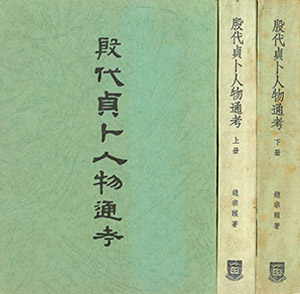
Year: 1959
Press: 香港大學出版社;香港

Year: 1996
Press: 漢城
【韓⽂版】

Year: 2015
Editor: 鄧偉雄
Press: 中華書局(香港)有限公司;香港
【重印本】(上、下冊)
1959 Edition (Traditional Chinese):
Hong Kong: Hong Kong University Press
1996 Edition (Korean):
Son Ye Cheol (1951- ), translator
Seoul: Minumsa
Professor Jao spent around 20 years researching diviners of the Yin dynasty with the unearthed oracle bones. The publication is considered a comprehensive study of the first-hand materials of the early Shang dynasty and received international attention. Today, the book review is in 13 languages and the Korean translation.
Foreword
The greater part of the books on the Oracle Bones that have appeared since their discovery, sixty years ago, have been compilations of inscriptions ranging from tiny fragments with a single character or part of a character, to a full-size plastron of a tortoise, or the shoulder-blade of an ox, engraved with over two hundred and fifty-three characters. With infinite care these have been transcribed, photographed, reproduced in rubbings, collated and studied, until from the whole known collection of some 100,000 fragments scattered through many lands, about 40,000 inscriptions have been numbered and recorded and made available to scholars throughout the world.
In contrast to this work of reproducing, recording, and cataloguing, comprehensive studies have been comparatively few. The Yin-hsu shu-ch'I k’ao-shih 殷虛書契考釋 ( “Interpretation of the Inscriptions from the Waste of Yin’) by Lo Chen-yu 羅振玉 (1914), was the first of these, followed by the special studies of Wang Kuo-wei 王國維, which were afterwards collected in the posthumous Kuan T’ang tsi-lin. 觀堂集林. The Preliminary Reports on the Excavations at An-yang 安陽發掘報告, published by the Academia Sinica 1929-1933, include numerous papers on various aspects of the newly excavated material; while the monumental Chia-ku wen tuan-tai yen-chiu li 甲骨文斷代研究例 ( ‘The Method of Determining the Periods of the Oracle Bones’) by Tung Tso-pin 董作賓 in 1933 was the most important comprehensive study on the Oracle Bones published in the period immediately preceding the war. During the war the chief contributions were the Chia-ku hsueh Shang-shih lun-ts'ung 甲骨學商史論叢 ( ‘Collected Essays on Shang History from the Oracle Bones’) by Hu Hou-hsuan 胡厚宣, published in three series from 1944 to 1946; and the Yin-li p’u 殷曆譜 ( ‘The Calendar and Chronological Studies of the Yin Dynasty’) by Tung Tso-pin published in 1945. After the war much valuable material collected by Hu Hou-hsuan was published on the Mainland, and a complete corpus of inscriptions on Oracle Bones excavated at An-yang was published in four volumes by the Academia Sinica, now in Taiwan, between 1948 and 1953 (Hsiao-T'un: Inscriptions 小屯 殷虛文字). This recently published material has made available new sources for further study, of which Mr Jao has taken full advantage to produce a work on different lines from any followed so far.
To the present time no scholar has made a comprehensive study of the persons whose names appear on the Oracle Bones in connection with the divination ritual, that is to say, the actual diviners whose names are recorded in the divination inscriptions as officiating at the divination ceremonies.
This task has been undertaken by Mr Jao Tsung-i. Mr Jao has listed some 130 names which appear in all some 10,000 times on the Bones, being all names of persons, other than the King himself, participating in the divination ceremonies. Some occur only once or only a few times; some as many as 2,000 times or more. Collecting and transcribing every one of the sentences in which these names occur, Mr Jao has been able to present a picture of the activity of the diviners of the Yin dynasty, from the reigh of Wu-ting 武丁 to the end of the dynasty.
The period in which some of these persons lived is determined, by the appellations with which they address the deceased ancestors, to belong to the reigns of certain monarchs. The dating of the remainder is deduced by their association on the Oracle Bones with those of known date. Thus a large number of inscriptions, hitherto undated, is brought into the datable sphere.
The inscriptions in which the names of these diviners occur are arranged first under the names of the persons concerned, and next under the matters in connection with which they were called upon to divine: ‘the weather’, ‘the evening’, ‘the decade’, ‘sacrifices’, ‘coming and going’, ‘military expeditions’, ‘outlying regions’ etc., a survey of which is sufficient to reveal the matters which were of daily concern to the Yin people. A convenient, summary of these for Western readers can be seen in the list of Contents, given in English at the end of the work.
The divination ritual is discussed in relation to the divination rules preserved in the three Ritual Books, I-li 儀禮, Chou-li 周禮, and Li-chi 禮記, and others of the Chinese Classical books, each throwing light upon the other. Although compiled at a later date, the Ritual Books, as can be seen from resemblances on the Oracle Bones, are based upon ancient rites and usages derived from the dawn of Chinese history. The Oracle Bones thus provide the evidence for the ‘rites of Yin’ that Confucious admitted was lacking in his day. Similarly, in his study of the ‘idioms and phrases’ used by the different diviners, the author has revealed resemblances to the style of the Classical books that increase our confidence in the antiquity of the sources from which those books are derived.
Thus, this book of 1,400 pages, which might appear at first sight to be but a compendium of oracular sentences, many of which are in a fragmentary condition, is in reality a valuable source book for a systematic study of the Oracle Bones in relation to the Classical books, and does in fact provide in a convenient form a basis for the critical study of Yin dynasty history, society, and religion.
Mr Jao, who is a lecturer in Chinese literature at the University of Hong Kong, is peculiarly well fitted for the task. Ranging wide in his studies since his earliest days, he has for ten years devoted a large part of his energies to the study of the Oracle Bones, upon which he has already published a number of important papers, of which the following may be mentioned: Oracle Bones in Collections in Paris 巴黎所見甲骨錄, Hong Kong, December 1956; “Oracle Bones in Japanese Collections’ 日本所見甲骨錄, Journal of Oriental Studies, Volume III, No. 1 University of Hong Kong, January 1956 (published in June 1957); ‘Some Oracle Bones in Overseas Collections’ 海外甲骨錄遺, Journal of Oriental Studies, Volume IV, Nos. 1 and 2, University of Hong Kong (in the press).
In addition, Mr Jao is at present preparing for publication an encyclopedic work on the ‘Interpretation of the Divination Sentences’: Pu-tz'u i-cheng 卜辭義證.
In all these studies Mr Jao Tsung-i has combined a capacity og tireless work and comprehensive outlook with extraordinary exactitude and infinite attention to detail.
We wish to acknowledge with gratitude a generous grant from the Trustees of the Harvard-Yenching Institute by which the publication of this important work has been made possible.
F. S. DRAKE
University of Hong Kong
14th July, 1959